For 55 years the Tri-State Defender Newspaper published in Memphis, Tennessee and founded by John H. Sengtstacke (publisher of the Chicago Defender); has been “1one of the longest, continuously-published African-American papers in the United States”.
In addition to informative African-American news and having been active in the Civil Rights Movement; the Tri-State Defender also annually honors “Women of Excellence”.
“2Each woman must be an African-American executive, professional, businessperson or community leader with a proven record of accomplishment. She must be a positive role model who has influenced the lives of others and demonstrated an active role in the community.”
On March 5th; Tri-State Defender published an official nomination form. By the end of the month; Tri-State Defender began their selections from numerous nominees. Then on April 24, 2009 at The Tower Room, Clark Tower in Memphis, Tennessee; these 50 exceptionally influential African-American Women were honored! click to read the full story by Florence M. Howard at the Tri-State Defender Online.
Florence M. Howard served as Event Coordinator last year and for this year’s Women of Excellence High Tea honorees. Florence M. Howard “ is an entrepreneur and founder of Secret Shop Communicators (SSCOMM, Inc.), an 8-year-old consulting firm that offers training, event planning, public relations and market research services to businesses, nonprofit and governmental agencies.”
Mearl Purvis Anchor, FOX13 News hosted the event:
1. Tri-State Defender History
2.The search for 50 Women of Excellence
Showing posts with label African American. Show all posts
Showing posts with label African American. Show all posts
Monday, May 04, 2009
Tuesday, April 21, 2009
Cleopatra African American Heritage
 "Cleopatra may have been part-African and not Greek Caucasian, according to a British TV documentary to be shown this month." - Discovery Channel (read full article)
"The queen's sister Princess Arsinoe, found in Ephesus, Turkey, indicate that her mother had an "African" skeleton." - BBC News (listen to full audio)
Cleopatra, "in Saqqara, on Jan. 6. Queen Seshestet (2323-2291 BC), ruled Egypt as the first pharaoh of the 6th Dynasty." - Netscape
Currently, "Archaeologists in Egypt are about to start excavating a site that they believe could conceal the tombs of Antony and Cleopatra." - Giles Coren Times Online
"Cleopatra was immortalized by Shakespeare in his play Antony and Cleopatra and played by Elizabeth Taylor." - Answers.com
![Reblog this post [with Zemanta]](https://lh3.googleusercontent.com/blogger_img_proxy/AEn0k_sSMGUcUk3QnWeVNIZskh8Fz_1D_JMRKYLZo4oILZ9FrTYiLdnJHJjofRkY4A394IXT6PhayLmyA0aMQfEGbC9xoDGPpFznhbBFKHdSPaWDaE_RK-uJLyj0BF9lgNJBSZF_-En775wU-_FAgI7G5NPx=s0-d)
Monday, March 16, 2009
Honor! Festival

Honor! A Celebration of African American Cultural Legacy
A Festival Curated by Jessye Norman: March 4-23, 2009
March 4, 2009; Press release
NEW YORK, March 4 /PRNewswire-USNewswire/ -- On March 4, Carnegie Hall launches Honor! A Celebration of the African American Cultural Legacy, a festival saluting the enduring vitality, influence, and creativity of African American culture, curated by renowned soprano Jessye Norman. Running through March 23 with more than 20 events at Carnegie Hall, the Apollo Theater, and venues throughout New York City, Honor! celebrates African American music and its influence worldwide, with programs paying tribute to pioneering artists including Marian Anderson, Duke Ellington, Langston Hughes, and more in programs that showcase performances by leading artists of today representing classical, gospel, the Spiritual, blues, jazz, and popular music. Complete festival information is available at www.carnegiehall.org/honor.
The Honor! festival is bookended by two special programs at Carnegie Hall. On March 4, "Honor: Blues, Jazz, Rhythm and Blues, Soul and Beyond" features today's musical innovators in tribute to great popular music artists of the past. Musical Director Ray Chew joins Geri Allen, Terence Blanchard, Ron Carter, James Carter (jazz); James "Blood" Ulmer, Toshi Reagon (blues); Anthony Hamilton, Freddie Jackson, Leela James, Kem, Ryan Shaw (R&B, soul); Vernon Reid (rock); Doug E. Fresh and MC Lyte (hip-hop). The festival concludes with "Honor: The Voice" on March 23, a program bringing together acclaimed African American classical singers to pay tribute to icons who paved the way for succeeding generations. Featured singers include Harolyn Blackwell, Gregg Baker, Angela M. Brown, Nicole Cabell, Kevin Maynor, and Eric Owens. click to read more
Biography
"Jessye Norman is “one of those once-in-a-generation singers who is not simply following in the footsteps of others, but is staking out her own niche in the history of singing” (New York Times). This rich history continues to be made as she brings her sumptuous sound, her joy of singing, and her spontaneous passion to recital performances, operatic portrayals, and appearances with symphony orchestras and chamber music collaborators to audiences around the world. The sheer size, power, and luster of her voice share equal acclaim with that of her thoughtful music making, innovative programming of the classics, and fervent advocacy of contemporary music. Miss Norman’s collaborations with artists on the cutting-edge in their fields—Robert Wilson, Andre Heller, Bill T. Jones, Steve McQueen, and Laura Karpman—serve to add new dimensions and exciting new challenges to her work." continued
PERFORMANCES
Honor: Blues, Jazz, Rhythm and Blues, Soul, and Beyond
Wednesday, March 4 at 8:00 p.m. (Carnegie Hall; Stern Auditorium/Perelman Stage)
Honor! opens with a concert that pays tribute to the great African American popular music artists of the past. Each presentation will parallel an event in the bountiful history of performances by African American artists at Carnegie Hall. Ray Chew—Musical Director for NBC’s The Singing Bee, Showtime At the Apollo, and BET’s Sunday Best—is Music Director for the program. Featured artists for this program include pianist Geri Allen, trumpeter Terence Blanchard, bassist Ron Carter, and saxophonist James Carter (jazz); vocalist/guitarist James “Blood” Ulmer and vocalist/guitarist Toshi Reagon (blues); vocalists Ashford & Simpson, Anthony Hamilton, Freddie Jackson, Leela James, Kem, and Ryan Shaw (R&B, soul); guitarist Vernon Reid and vocalist Corey Glover (rock); rappers Doug E. Fresh and MC Lyte (hip-hop) and actor Avery Brooks. Emmy Award winning WABC news anchor Sade Baderinwa will host the program alongside actor Wendell Pierce from the acclaimed HBO’s series The Wire.
Carnegie Hall Neighborhood Concert: Imani Winds
Thursday, March 5 at 1:00 p.m. (CUNY Graduate Center’s Music in Midtown)
In the first of six free Carnegie Hall Neighborhood Concerts presented by The Weill Music Institute during Honor!, the Grammy-nominated wind quintet Imani Winds will perform a sneak preview of a new Carnegie Hall commission by Daniel Bernard Roumain at Manhattan’s CUNY Graduate Center (to be premiered on March 8; see Panel Discussions below). Since 1997, Imani Winds has sought to diversify and expand the wind quintet repertoire by incorporating diverse musical genres into their performances, including compositions by classical composers Elliott Carter, Luciano Berio, and György Ligeti and jazz artists Wayne Shorter and Paquito D’Rivera.
Sacred Ellington
Saturday, March 7 at 8:00 p.m. (The Cathedral of St. John the Divine)
Comprised of excerpts from Duke Ellington’s large-scale, three-part work known as the Sacred Concerts, Sacred Ellington features Jessye Norman in a program that pays homage to this legendary figure and his music. The concert, which features Miss Norman performing with Music Director/pianist Mark Markham, tap dancer Maurice Chestnut, dancer Margie Gillis, the Flux Quartet, the choir Sacred Voices, plus a jazz ensemble, takes place at The Cathedral of St. John the Divine, a special sanctuary of central importance in Ellington’s life and where he gave the premiere of his Second Sacred Concert in January 1968. Less than four months later, on April 4, 1968, Ellington performed excerpts from the Second Sacred Concert at Carnegie Hall, where it was announced from the stage prior to the start that Martin Luther King, Jr., had just been assassinated. The concert was subsequently performed in memory of Dr. King.
Carnegie Hall Neighborhood Concert: Esperanza Spalding
Thursday, March 12 at 7:00 p.m. (Schomburg Center for Research in Black Culture)
Twenty-three-year-old bassist/vocalist/composer Esperanza Spalding performs a free Neighborhood Concert at Manhattan’s Schomburg Center for Research in Black Culture. Spalding’s fresh approach to jazz—mixing pop, soul, and Latin music bolstered by classical music training—made her the youngest professor in the history of the prestigious Berklee College of Music where she had studied since age 16.
Carnegie Hall Neighborhood Concert: Community Sing with Gospel for Teens
Friday, March 13 at 6:30 p.m. (Apollo Theater’s Soundstage)
The Gospel for Teens Choir will join host Vy Higginsen at the Apollo Theater’s Soundstage for a free Community Sing where audience members are invited to come together and sing along with the choir. Higginsen, writer/producer/director of the 1984 musical Mama, I Want to Sing, founded Mama Foundation for the Arts and its Gospel for Teens Program, which teaches aspiring teenagers about the importance of gospel music as an art form.
Carnegie Hall Neighborhood Concert: Harlem Quartet, A Sphinx Ensemble
Saturday, March 14 at 2:00 p.m. (Langston Hughes Community Library & Cultural Center)
The Harlem Quartet, comprised of First Place Laureates of the Sphinx Competition, will engage the audience in this free Neighborhood Concert highlighting works by minority composers at the Langston Hughes Community Library & Cultural Center of the Queens Library. The Harlem Quartet made their acclaimed debut in the fall of 2006 at the Sphinx Organization’s Gala Concert at Carnegie Hall.
Ask Your Mama!
Monday, March 16 at 8:00 p.m. (Carnegie Hall; Stern Auditorium/Perelman Stage)
Soprano Jessye Norman, hip-hop group The Roots, and vocalists de’Adre Aziza and Tracie Luck are the featured artists in the world premiere performance of Ask Your Mama!, an extraordinary multimedia concert production from composer Laura Karpman commissioned by Carnegie Hall. Based on Ask Your Mama: 12 Moods for Jazz, Langston Hughes’ 1961 poem cycle about African-American life, music, and culture, this collaboration between the four-time Emmy Award-winning composer Karpman and the five-time Grammy Award-winning soprano Norman will be directed by Annie Dorsen (Passing Strange) with conductor George Manahan leading the Orchestra of St. Luke’s. Artist Rico Gatson will provide visuals.
The Philadelphia Orchestra
Tuesday, March 17 at 8:00 p.m. (Carnegie Hall; Stern Auditorium/Perelman Stage)
Chief Conductor Charles Dutoit and The Philadelphia Orchestra return to Carnegie Hall for a program dedicated to the great soprano Marian Anderson, featuring bass-baritone Eric Owens singing Mahler’s Lieder eines fahrenden Gesellen. Anderson, a native of Philadelphia, performed at Carnegie Hall 56 times throughout her life, the third-most performances by an African American musician behind trumpeters Dizzy Gillespie and Jon Faddis. The program also features African American composer George Walker’s 1996 Pulitzer Prize-winning work Lilacs with tenor Russell Thomas and European classical works inspired by African American music including Milhaud’s La création du monde and Dvořák’s Symphony No. 9 in E Minor, “From the New World.”
Dee Dee Bridgewater
Wednesday, March 18 at 8:30 p.m. (Carnegie Hall; Zankel Hall)
Grammy- and Tony Award-winning vocalist Dee Dee Bridgewater presents an evening of original music and jazz standards. Noted by The New York Times as “a woman of a thousand voices [with the] stage personalities to match,” Ms. Bridgewater has performed on Broadway and with jazz legends such as Sonny Rollins, Dizzy Gillespie, Dexter Gordon, and Max Roach, earning her the reputation of a consummate entertainer. Ms. Bridgewater also hosts the syndicated weekly NPR radio show, JazzSet with Dee Dee Bridgewater.
Carnegie Hall Neighborhood Concert:
McCollough Sons of Thunder & Hypnotic Brass Ensemble
Thursday, March 19 at 7:30 p.m. (Harlem Stage/Aaron Davis Hall, Inc.)
The McCollough Sons of Thunder, a “shout” gospel brass band ensemble, and Hypnotic Brass Ensemble, made up of seven sons of the jazz trumpeter Phil Cohran, will perform two free Neighborhood Concerts, first at Harlem Stage/Aaron Davis Hall, Inc., and then Brooklyn’s Kingsborough Community College Performing Arts Complex. The “shout” band, a tradition deeply rooted in the African-American church, is quickly gaining recognition in larger circles, and the McCollough Sons of Thunder provide a unique fusion of these traditions with brass band instruments.
Carnegie Hall National High School Choral Festival
Friday, March 20 at 8:00 p.m. (Carnegie Hall; Stern Auditorium/Perelman Stage)
Presented by Carnegie Hall’s Weill Music Institute, the National High School Choral Festival features choirs from Georgia, New York, New Jersey, and Washington, chosen by audition, performing Sir Michael Tippett’s A Child of Our Time, a work that utilizes the African American Spiritual in much the same way that Bach employed chorales in his choral masterworks. Craig Jessop, former Music Director of the Mormon Tabernacle Choir conducts the Orchestra of St. Luke’s. Soloists include soprano Angela M. Brown, contralto Meredith Arwady, tenor Russell Thomas, and bass Morris Robinson. Throughout the year, the four chosen choirs have rehearsed the work and will have intensive rehearsals in New York the week prior to the performance. At the performance, each choir will also perform its own set led by their own choir directors.
Emancipation's Jubilations: Spirituals and Songs that Led a Nation
Saturday, March 21 at 3:00 p.m. (New York Public Library for the Performing Arts)
Presented by the New York Public Library for the Performing Arts as part of its series Mystic Chords of Memory: Abraham Lincoln and the Performing Arts, baritone James Martin performs a recital based on songs Lincoln heard at a contraband camp (a refuge for escaped slaves), including "Nobody Knows the Trouble I've Seen," "Every Time I Feel the Spirit," "I Thank God that I Am Free at Last," "John Brown's Body," "Swing Low, Sweet Chariot," "Didn't My God Deliver Daniel," "Go Down, Moses," "I Ain't Got Weary Yet," "I've Been in the Storm So Long," "Steal Away," and "Praise God from Whom Blessings Flow."
Carnegie Hall Neighborhood Concert:
McCollough Sons of Thunder & Hypnotic Brass Ensemble
Sunday, March 22 at 3:00 p.m. (Kingsborough Community College Performing Arts Complex)
See Thursday, March 19.
A Celebration of the Spiritual and Gospel Music
Sunday, March 22 at 5:00 p.m. (Apollo Theater)
A weekend devoted to the Spiritual and gospel music at the Apollo Theater begins with a panel discussion on Saturday, March 21 (see below). Then, on Sunday, a concert traces the development of the Spiritual from its African roots through solo vocal performances and choral arrangements. Following intermission, choirs from around New York City join forces for a joyous celebration of gospel music. Music Director Ray Chew is joined by gospel singers Shari Addison, Shirley Caesar, Donnie McClurkin, Smokie Norful, and Richard Smallwood, the Abyssinian Baptist Church Cathedral Choir, Hezekiah Walker and the Love Fellowship Choir, Sweet Honey In The Rock, and Vy Higginsen’s Gospel for Teens Choir.
Honor: The Voice
Monday, March 23 at 8:00 p.m. (Carnegie Hall; Stern Auditorium/Perelman Stage)
In the Honor! closing program, acclaimed African American singers from the classical world come together to pay tribute to icons who opened the doors for succeeding generations. Featured performers are sopranos Harolyn Blackwell, Angela M. Brown, and Nicole Cabell; baritone Gregg Baker; bass-baritone Eric Owens; and bass Kevin Maynor.
* * * *
PANEL DISCUSSIONS
Panel Discussions
Sunday, March 8 (Carnegie Hall; Zankel Hall)
12:00 p.m.—Exploration: A Panel Discussion
Attorney Gordon J. Davis; author Michael Eric Dyson; Dr. Luvenia A. George, author and developer of the Duke Ellington and Louis Armstrong curriculum for the Smithsonian Institute; composer Laura Karpman; conductor Rachael Worby; and scholar Cornel West offer a wide ranging discussion on music today ranging from hip-hop and jazz to contemporary orchestral music. Following the discussion, Imani Winds will perform Five Chairs and One Table, a new work by Daniel Bernard Roumain, commissioned by Carnegie Hall. The piece portrays a history of African and African-American song and struggle and includes brief musical portraits dedicated to Jessye Norman, South African singer and civil rights activist Miriam Makeba (1932-2008), the folk singer Odetta (1930-2008), and the daughters of Barack and Michelle Obama, Malia and Sasha. Imani Winds will also perform the New York premiere of Cane by jazz pianist and composer Jason Moran.
3:30 p.m.—Impression: A Panel Discussion
Composer/conductor Tania León, author Toni Morrison, tenor and professor George Shirley, and actress and playwright Anna Deavere Smith take part in an afternoon of reminiscences and anecdotes of a life in the arts. Leading figures discuss their individual performance experiences on the international stages. Baritone Robert Sims and pianist Paul Hamilton will conclude the event with a 20-minute performance.
7:00 p.m.—Expression: A Panel Discussion
Poet and award-winning writer Maya Angelou, scholar Henry Louis Gates, Jr., journalist Gwen Ifill, artistic director of Alvin Ailey American Dance Theater Judith Jamison, musicologist Portia Maultsby, and dancer and choreographer Arthur Mitchell of Dance Theatre of Harlem participate in a discussion of the history of African American performing arts and its role in social and political change. The event will conclude with a performance by Dance Theatre of Harlem School and Ensemble.
Dance Theatre of Harlem: Classically American
Thursday, March 12 at 3:00 p.m. (New York Public Library for the Performing Arts)
As part of its multimedia exhibition, Dance Theatre of Harlem: 40 Years of Firsts, running from February 11 to May 9, the New York Public Library for the Performing Arts presents this panel discussion with moderator Alastair Macauley and panelists Suzanne Farrell, Frederic Franklin, and Lorraine Graves exploring the lasting legacy of this important cultural institution. Additional panelists are to be announced.
THE STORIES I COULD TELL: Arthur Mitchell at 75
Thursday, March 12 at 5:30 p.m. (New York Public Library for the Performing Arts)
As part of its multimedia exhibition, Dance Theatre of Harlem: 40 Years of Firsts, running from February 11 to May 9, the New York Public Library for the Performing Arts presents an interview with Arthur Mitchell, the Founding Artistic Director of the Dance Theatre of Harlem, moderated by Robert Greskovic.
Panel Discussion: The Spiritual and Gospel Music
Saturday, March 21 at 7:00 p.m. (Apollo Theater)
Distinguished figures discuss the historical, political, and musical issues associated with this music. Participants include Derrick Bell, Dr. Calvin O. Butts III, Portia Maultsby, Chapman Roberts, Sweet Honey in the Rock, and Olly Wilson.
click for more info: http://www.carnegiehall.org/article/press/press_release/111721.html
Monday, February 23, 2009
He Plowed The Path to African-Americans US Citizenship
 ASALH (The Association for the Study of African American Life and History) - the Founders of Black History Month, is a non-profit organization established on September 9, 1915 by Dr. Carter G. Woodson. The 2009 Black History Theme is “The Quest for Black Citizenship in the Americas”.
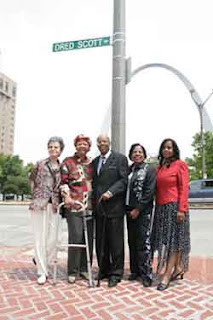
  In keeping with this years theme, I’d like to present Dred Scott:
Dred Scott (1799 – September 17, 1858), was a slave in the United States who sued unsuccessfully for his freedom in the infamous Dred Scott v. Sandford case of 1857. His case was based on the fact that he and his wife Harriet were slaves, but had lived in states and territories where slavery was illegal, including Illinois and Minnesota (which was then part of the Wisconsin Territory). The United States Supreme Court ruled seven to two against Scott, finding that neither he, nor any person of African ancestry, could claim citizenship in the United States, and that therefore Scott could not bring suit in federal court under diversity of citizenship rules. Moreover, Scott's temporary residence outside Missouri did not effect his emancipation under the Missouri Compromise, since reaching that result would deprive Scott's owner of his property. source Wikipedia
“Roswell M. Field was a prominent lawyer in St. Louis and also the father of journalist and poet Eugene Field”. “Field took few slave cases, but when he did, he represented slaves. Even then, however he had but limited experience with the law of slavery when he became Dred Scott's attorney. Scott had filed his freedom suit in the spring of 1846; six years later, after "bitterly fought" (p. 180) and complex litigation, and after the Missouri Supreme Court reversed itself on freedom suits, Field became Scott's attorney.” source Humanities & Social Sciences Online
“The Eugene Field House was the home of Eugene's father Roswell Field, the attorney who formulated the legal strategy that placed slave Dred Scott's lawsuit for freedom before the U. S. Supreme Court. In Scott v. Sandford, one of the most controversial cases of the 19th century, Supreme Court Chief Justice Roger B. Taney declared that no slave could be a U.S. citizen and that the Missouri Compromise of 1820 (that abolished slavery in most territories) was unconstitutional. The 1857 decision widened the political gap between the North and the South and helped precipitate the Civil War. A very outspoken critic of the decision was Abraham Lincoln, a relatively unknown Illinois lawyer, whose attacks on the case thrust him into the national political scene. Anger over Taney's decision energized the Republican party and led the nation's first antislavery political party to victory in 1860. It took the civil war and post-war constitutional amendments to overturn the Dred Scott decision.” source Eugene Field House and St. Louis Toy Museum
(source from Dred Scott Case Collection):"1858 Dred Scott dies of tuberculosis and is buried in St. Louis. He was buried in Wesleyan Cemetery at what is now the intersection of Grand and Laclede Avenues in St. Louis (now part of the campus of St. Louis University). In 1867, Wesleyan cemetery closed and the bodies were disinterred and re-buried at other sites. Dred Scott's body was moved to an unmarked grave in Section 1, Lot No. 177, Calvary Cemetery, in north St. Louis County. In 1957 a marker was placed on Dred Scott's grave which reads":
"DRED SCOTT BORN ABOUT 1799 DIED SEPT. 17, 1858 DRED SCOTT SUBJECT OF THE DECISION OF THE SUPREME COURT OF THE UNITED STATES IN 1857 WHICH DENIED CITIZENSHIP TO THE NEGRO, VOIDED THE MISSOURI COMPROMISE ACT, BECAME ONE OF THE EVENTS THAT RESULTED IN THE CIVIL WAR"

*The back of the tombstone says, "Freed from slavery by his Friend Taylor Blow."
“On its way to the United States Supreme Court, the Dred Scott case grew in scope and significance as slavery became the single most explosive issue in American politics. By the time the case reached the high court, it had come to have enormous political implications for the entire nation. On March 6, 1857, Chief Justice Roger B. Taney read the majority opinion of the Court, which stated that black people were not citizens of the United States and, therefore, could not expect any protection from the federal government or the courts; the opinion also stated that Congress had no authority to ban slavery from a federal territory. The decision of Scott v. Sandford, considered by legal scholars to be the worst ever rendered by the Supreme Court, was overturned by the 13th and 14th amendments to the Constitution (1865-1868), which abolished slavery and declared all persons born in the United States to be citizens of the United States.” source National Archives and Records Administration
(Complete poem American Poems)
BETTER DIE FREE,
THAN TO LIVE SLAVES.
Who said those things? Americans!
Who owns those words? America!
Who is America? You, me!
We are America!
To the enemy who would conquer us from without,
We say, NO!
To the enemy who would divide
And conquer us from within,
We say, NO!
FREEDOM!
BROTHERHOOD!
DEMOCRACY!
To all the enemies of these great words:
We say, NO!
A long time ago,
An enslaved people heading toward freedom
Made up a song:
Keep Your Hand On The Plow! Hold On!
The plow plowed a new furrow
Across the field of history.
Into that furrow the freedom seed was dropped.
From that seed a tree grew, is growing, will ever grow.
That tree is for everybody,
For all America, for all the world.
May its branches spread and shelter grow
Until all races and all peoples know its shade.
KEEP YOUR HAND ON THE PLOW! HOLD ON!
Please visit The Dred Scott Heritage Foundation
Monday, January 19, 2009
Inauguration Day Transformation
 "My strongest conviction as to the future of the negro therefore is, that he will not be expatriated nor annihilated, nor will he forever remain a separate and distinct race from the people around him, but that he will be absorbed, assimilated, and will only appear finally, as the Phoenicians now appear on the shores of the Shannon, in the features of a blended race. I cannot give at length my reasons for this conclusion, and perhaps the reader may think that the wish is father to the thought, and may in his wrath denounce my conclusion as utterly impossible. To such I would say, tarry a little, and look at the facts. Two hundred years ago there were two distinct and separate streams of human life running through this country. They stood at opposite extremes of ethnological classification: all black on the one side, all white on the other. Now, between these two extremes, an intermediate race has arisen"...read more THE FUTURE OF THE COLORED RACE by Frederick Douglass (February 14, 1818 – February 20, 1895)
Of significance, "In 1872, Frederick Douglass became the very first African-American nominated as a Vice Presidential candidate in the U.S., running on the Equal Rights Party ticket..." Wikipedia
Remarkably, during a time that Frederick Douglass lived to speak at Abraham Lincoln's death to this current date, his convictions of the African-American People has prevailed in the aspect of hope and triumph. For Tuesday Barack Obama will be sworn in as the 44th president of the United States. Notably Barack Obama has chosen the Bible used by Abraham Lincoln in his inauguration in 1861.
"While drawing encouragement from the Declaration of Independence, the great principles it contains, and the genius of American Institutions, my spirit is also cheered by the obvious tendencies of the age. Nations do not now stand in the same relation to each other that they did ages ago. No nation can now shut itself up from the surrounding world, and trot round in the same old path of its fathers without interference. The time was when such could be done. Long established customs of hurtful character could formerly fence themselves in, and do their evil work with social impunity. Knowledge was then confined and enjoyed by the privileged few, and the multitude walked on in mental darkness. But a change has now come over the affairs of mankind. Walled cities and empires have become unfashionable. The arm of commerce has borne away the gates of the strong city. Intelligence is penetrating the darkest corners of the globe. It makes its pathway over and under the sea, as well as on the earth. Wind, steam, and lightning are its chartered agents. Oceans no longer divide, but link nations together." What to the Slave is the Fourth of July? Frederick Douglass
Sunday, June 15, 2008
Local Band!

Jun 21 2008 10:00P Frankie Biggs James Island, SC
Jul 4 2008 10:00P Folly Beach (Roadhouse) Folly Beach, SC
Aug 8 2008 10:00P Folly Beach (Roadhouse) Folly Beach, SC
For Booking:(843) 763-1392 (843) 813-0675
Saturday, February 16, 2008
Multiculturalism
 Multiculturalism is different cultures or cultural identities within a Society that includes African-American, Asian American, European American, Jewish American, Latino/Chicano/Hispanic American, Native Americans, etc. This February is dedicated to the origins of African-American multiculturalism and the Founder of the professional non-profit organization ASALH (The Association for the Study of African American Life and History), Carter G. Woodson.
 Woodson whom is known as the Father of Black History, pioneered an intellectual movement to educate Americans about cultural diversity and democracy. My opinion is that a large part of African American history includes literature in publication throughout educational institutions and made readily available to the public.
U.S. Society & Values: “The actual study of multicultural literature has come about gradually during the past three decades. A student in a representative university in the late 1960s might have come upon one or two writers, at most, in his American literature survey course. This was linked, as always, to the publishing industry, to what publishers in the United States were issuing, less than to racism and elitism. The first challenge within the academic community was to successfully argue the case for ethnic literature in the curriculum. The second was to convince publishers of the merits of this body of work. Alice Walker, author of The Color Purple and many other books, has recalled reading a photocopy version of Hurston's landmark novel in graduate school, and wondering why she had never heard of it, and moreover, why it wasn't available anywhere in print.” (click to read complete article)
Wikipedia: “African American literature is the body of literature produced in the United States by writers of African descent. The genre traces its origins to the works of such late 18th century writers as Phillis Wheatley and Olaudah Equiano, reaching early high points with slave narratives and the Harlem Renaissance, and continuing today with authors such as Toni Morrison, Maya Angelou and Walter Mosley being ranked among the top writers in the United States. Among the themes and issues explored in African American literature are the role of African Americans within the larger American society, African-American culture, racism, slavery, and equality. African American writing has also tended to incorporate within itself oral forms such as spirituals, sermons, gospel music, blues and rap.
As African Americans' place in American society has changed over the centuries, so, too, have the foci of African American literature. Before the American Civil War, African American literature primarily focused on the issue of slavery, as indicated by the subgenre of slave narratives. At the turn of the 20th century, books by authors such as W.E.B. DuBois and Booker T. Washington debated whether to confront or appease racist attitudes in the United States. During the American Civil Rights movement, authors such as Richard Wright and Gwendolyn Brooks wrote about issues of racial segregation and black nationalism. Today, African American literature has become accepted as an integral part of American literature, with books such as Roots: The Saga of an American Family by Alex Haley, The Color Purple by Alice Walker, and Beloved by Toni Morrison achieving both best-selling and award-winning status.”
This month Binding Ink is pleased to have presented a three part series to include the first three African-American Poets in the U.S.: Lucy Terry, Jupiter Hammon, and Phillis Wheatley. However; “1There are, it seems, some differences of opinion even among scholars about where the study of black written poetry begins. Some, like Hughes and Bontemps in The Poetry of the Negro, begin with Lucy Terry, but The Negro Caravan, by Brown, Davis and Lee omits her altogether and opens with Phillis Wheatley. William H. Robinson acknowledges Terry in Early Black.”
Notably, historians also “disagree as to when the Harlem Renaissance began and ended”:
Wikipedia: “The Harlem Renaissance (also known as the Black Literary Renaissance and The New Negro Movement) refers to the flowering of African American cultural and intellectual life during the 1920s and 1930s. At the time, it was known as the "New Negro Movement", named after the anthology The New Negro, edited by Alain Locke in 1925. Centered in the Harlem neighborhood of New York City, the movement impacted urban centers throughout the United States. Across the cultural spectrum (literature, drama, music, visual art, dance) and also in the realm of social thought (sociology, historiography, philosophy), artists and intellectuals found new ways to explore the historical experiences of black America and the contemporary experiences of black life in the urban North.”
I found an excellent and highly recommended web site called African American Literature that covers African American Literature during the Twentieth Century, including the Harlem Renaissance and is geared to such knowledge being available especially in the educational system. The site includes: “75 novels, poems, autobiographies, and essays along with summaries of the selected literature. Also, we have provided you with some significant events of each decade and the literary themes that African American authors were writing about during that decade.”The array includes:
1920: “The start of the Harlem Renaissance, a period of creativity among Black artists, writers, musicians, and entertainers…”
1930: “With the slowing of African American writing during the Great Depression, African Americans confronted many new challenges and obstacles. During the 1930s, the United States voted for a new president and the government made promises to the African American community that they could not keep. Blacks were fighting for equal pay, educational facilities and equal protection under the law. Black authors voiced their rage and frustrations in their work. They still possessed the same intensities as they did during the Harlem Renaissance but the motivation and themes addressed changed. African American authors tackled themes such as racism, poverty,self-assertion,and race relations. “
1940: “A very transitional period for the United States and for African Americans. The Forties was marked by more African American enlisting in all branches of the military and the start of World War II. During this time period, African Americans were fighting for the right to enlist in combat roles in the armed forces. At this time, Blacks were primarily segregated and assigned only in noncombat roles. Whites responded to Black demands with lynchings, town burnings, and other forms of violence. The authors during this period continued the tradition of race and socially conscious writing. Literature with black themes of struggle, oppression, and daily life were often found in the works of the African American authors.”
1950: “A very politically unstable time for African Americans. Their rights were constantly under attack. All the efforts made during the Forties to integrate the Armed Forces were abolished during the Korean War. A new era of racist assassinations began to occur and African Americans started to take a stand against blatant racism. The NAACP argued cases in Southern states against the discriminatory practices in public schools. In May of 1954, the Brown vs. Board of Education occurred. This case ruled racial segregation in public schools to be unconstitutional. The African American non-violent movement began taking the form of boycotts, sit-ins, and peaceful protests. The African American authors during this decade were writing about love, discrimination, the prison system, protest, black sexuality, and black life in Harlem.”
1960: “considered by many to be the Second Black Renaissance. It was African- American's most significant decade in terms of self-consciousness, goals, and achievements. In contrast, the Harlem Renaissance was in part fostered by white patrons and declined when white's financial support declined after the Crash of 1929. But the 1960s was self-generating, self- determining, and self-sustaining. Many significant events occurred during the 1960s such as the March on Washington, countless civil right demonstrations. The Sixties also saw the assassination of two Black America's greatest leaders: Rev. Martin Luther King Jr. and Malcolm X. New cries of black nationalism, black separatism, and violent resistance were often heard in African-American communities. The authors during this time addressed such themes as black pride, self- actualization, black sexuality, justice, and race relations.”
1970: “a time when African culture was adopted by African-Americans. The U.S government began to monitor Black organizations. Vietnam War ended and many African Americans soldiers faced many disappointments. Many Black Soldiers found that their lives were not improved by fighting in a war that was not theirs. Shirley Chisolm became the first black woman to run for the U.S. presidency. The Seventies saw the emergence of an open and ongoing discussion among Black men and women on the quality, forms and future of their relationships. African American authors still voiced their frustrations and desires in their writings, but many authors wrote about the same literary themes as in the Sixties.”
1980: “a time in history when Reganomics had expanded the gap in the economy to the point that poverty among blacks was at an all time high. Crack had hit the African American community harder than any other drug in the past. Martin Luther King Jr.'s birthday was established as a national holiday and Jesse Jackson ran for president. The Eighties was a time when female authors burst onto the scene. Publishing companies witnessed the enhancement of established talent among African American female writers. These writers became apart of America's pop culture and started to float in society's mainstream. African American authors discussed themes such as black female-male relationships, self-identity, and more authors had female main characters depicted in their works.”
1990: “has been categorized as the "Attack on the Black Male." The number of black males being put in prisons and killed on the streets increased tremendously in the nineties. Black on Black crime has risen at an astronomical rate. The nineties saw the Freeing of South Africa, Million Man March, the L.A. Riots, O.J. Simpson trial, increases in police brutality, and the murder of Tupac Shakur. Racial tension has increased dramatically over the decades with church burnings, recorded police beatings, hate crimes, and an attack on affirmative action. Black literature during the Nineties includes themes such as Black female-male relationships, urban life, self-awareness, economic power and black unity.”
In conclusion, Binding Ink would like to ask your support in helping to keep African-American multiculturalism literature alive; merely read, become knowledgeable, enjoy, and most of all - regardless of ethnicity, don’t be afraid to pick up a pen and write. Be a part of and add to future generations of history.
1. Memorial Hall
Technorati Tags Multiculturalism,Black History Month,African American Literature,Binding Ink
Sunday, February 10, 2008
1st Poem Composed by an African American Woman
 Memorial Hall: "Much in the achievements of Jupiter Hammon of Long Island and Lucy Terry Prince of Massachusetts and Vermont offers food for comparison. The pioneer black poet and poetess share race and literary priority as well as social status as chattel property in 18th-century America. Hammon has already received a measure of recognition as the first published African-American poet, with his broadside An Evening Thought: Salvation by Christ With Penetential Cries, in 1761. Hammon's fame, nevertheless, rests on but seven poems and four prose pieces discovered eightyseven years ago.
Lucy Terry Prince, on the other hand, is credited with but a single poem, composed fourteen years before Hammon, although not until recently recognized as the first poetry by any black American. Both Hammon and Prince, however, have been overshadowed by Phillis Wheatley, whose precocity attracted attention in her own time and won for her contemporary literary recognition here and abroad.
There are, it seems, some differences of opinion even among scholars about where the study of black written poetry begins. Some, like Hughes and Bontemps in The Poetry of the Negro, begin with Lucy Terry, but The Negro Caravan, by Brown, Davis and Lee omits her altogether and opens with Phillis Wheatley. William H. Robinson acknowledges Terry in Early Black."
Wikipedia: Lucy Terry was kidnapped in West Africa as an infant and sold into slavery. She was owned by Ebenezer Wells of Deerfield, Massachusetts, who allowed her to be baptized into the Christian faith at about five years of age during the Great Awakening.
PBS: Although best known as the author of the first poem composed by an African American woman, Lucy Terry Prince was a remarkable woman whose many accomplishments included arguing a case before the Supreme Court.
In 1756, Lucy Terry married Abijah Prince, a prosperous free black man who purchased her freedom.
The African American Registry: When a Colonel Eli Bronson attempted to steal land owned by the Princes, as a persuasive orator; Terry successfully negotiated a land case before the Supreme Court of Vermont in the 1790s. She argued against two of the leading lawyers in the state, (one of who later became the Chief Justice of the Supreme Court of Vermont) and won her case against the false land claims of Colonel Eli Bronson. Samuel Chase, the presiding justice of the Court, said that her argument was better than he'd heard from any Vermont lawyer.
Wikipedia: Although Lucy Terry was a poet, only one of her poems, a ballad called "Bars Fight" has survived, about an attack upon two white families by Native Americans on August 25, 1746. The attack occurred in Deerfield, in an area called "The Bars," which was a colonial term for a meadow.
African American Literature: Lucy Terry's " Bars Fight ", was first published in 1855 in Josiah Holland's History of Western Massachusetts.
Lucy Terry died in 1821, at the age of 97.
BARS FIGHT
Samuel Allen like a hero fout
And though he was so brave and bold
His face no more shall we behold.
Eleazer Hawks was killed outright
Before he had time to fight
Before he did the Indians see
Was shot and killed immediately.
Oliver Amsden he was slain
Which caused his friends much grief and pain
Samuel Amsden they found dead
Not many rods off from his head.
Adonijah Gillet we do hear
Did lose his life which was so dear.
John Saddler fled across the water
And so escaped the dreadful slaughter.
Eunice Allen see the Indians coming
And hoped to save herself by running
And had not her petticoats stopt her
The awful creatures had not cotched her
And tommyhawked her on the head
And left her on the ground for dead.
Young Samuel Allen, Oh! lack a-day
Was taken and carried to Canada.
Technorati Tags Lucy Terry,Black History Month,Poet,Binding Ink
Friday, February 08, 2008
America's 1st Published African-American Writer
 George Wallace: Jupiter Hammon’s first published work, an 88-line broadside, came out in Hartford, Connecticut in 1760 -- when Phillis Wheatley was only seven years old and ten years prior to her first broadside publication, entitled “Elegy on the death of Whitefield.”
Wikipedia: Hammon was a slave his whole life, owned by several generations of the Lloyd family on Long Island, New York. However, he was allowed to attend school, and thus (unlike many slaves) was able to read and write.
The Address to the Negroes of the State of New York, or the Hammon Address, was a speech by Jupiter Hammon,...Hammon delivered the speech, in which he expressed his opinions on slavery, before the African Society on 24 September 1786.

Jupiter Hammon wrote the speech at age seventy-six after a lifetime of slavery in Long Island, New York. In the speech, Hammon gives his famous quote, "If we should ever get to Heaven, we shall find nobody to reproach us for being black, or for being slaves."
Perspectives in American Literature: Hammon was also a preacher for his fellow brethren on the Lloyd Manor Estate.
Questia: The American Revolution, which interrupted the comfort and stability of the poet-preacher's life, was the central political event of Hammon's experience. By the time of the struggle, the Lloyd family had split into Loyalist and Whig factions. When the British occupied Long Island in 1776, the sixty-five-year-old Jupiter Hammon went to Connecticut with two Lloyd Whigs, his second master, Joseph Lloyd (Henry's son) and John Lloyd II, Joseph's nephew. They lived first in Stamford and later in Hartford. Joseph Lloyd committed suicide mistakenly believing that the British had captured Charleston, South Carolina and were about to win the war.
Unfortunately, 1“The actual death date of Jupiter Hammon is not known because no one can find a death certificate or the exact spot of his burial”, it is estimated between 1790 and 1806.
Hammon first work:
An Evening Thought: Salvation by Christ, with Penetential Cries by Jupiter Hammon:
Salvation comes by Christ alone,
The only Son of God;
Redemption now to every one,
That love his holy Word.
Dear Jesus, we would fly to Thee,
And leave off every Sin,
Thy tender Mercy well agree;
Salvation from our King.

Salvation comes now from the Lord,
Our victorious King.
His holy Name be well ador'd,
Salvation surely bring.
Dear Jesus, give thy Spirit now,
Thy Grace to every Nation,
That han't the Lord to whom we bow,
The Author of Salvation.
Dear Jesus, unto Thee we cry,
Give us the Preparation;
Turn not away thy tender Eye;
We seek thy true Salvation.
Salvation comes from God we know,
The true and only One;
It's well agreed and certain true,
He gave his only Son.
Lord, hear our penetential Cry:
Salvation from above;
It is the Lord that doth supply,
With his Redeeming Love.
Dear Jesus, by thy precious Blood,
The World Redemption have:
Salvation now comes from the Lord,
He being thy captive slave.
Dear Jesus, let the Nations cry,
And all the People say,
Salvation comes from Christ on high,
Haste on Tribunal Day.
We cry as Sinners to the Lord,
Salvation to obtain;
It is firmly fixed, his holy Word,
Ye shall not cry in vain.
Dear Jesus, unto Thee we cry,
And make our Lamentation:
O let our Prayers ascend on high;
We felt thy Salvation.
Lord, turn our dark benighted Souls;
Give us a true Motion,
And let the Hearts of all the World,
Make Christ their Salvation.
Ten Thousand Angels cry to Thee,
Yea, louder than the Ocean.
Thou art the Lord, we plainly see;
Thou art the true Salvation.
Now is the Day, excepted Time;
The Day of the Salvation;
Increase your Faith, do not repine:
Awake ye, every Nation.
Lord, unto whom now shall we go,
Or seek a safe abode?
Thou has the Word Salvation Too,
The only Son of God.
Ho! every one that hunger hath,
Or pineth after me,
Salvation be thy leading Staff,
To set the Sinner free.
Dear Jesus, unto Thee we fly;
Depart, depart from Sin,
Salvation doth at length supply,
The Glory of our King.
Come, ye Blessed of the Lord,
Salvation greatly given;
O turn your Hearts, accept the Word,
Your Souls are fit for Heaven.
Dear Jesus, we now turn to Thee,
Salvation to obtain;
Our Hearts and Souls do meet again,
To magnify thy Name.
Come, Holy Spirit, Heavenly Dove,
The Object of our Care;
Salvation doth increase our Love;
Our Hearts hath felt they fear.
Now Glory be to God on High,
Salvation high and low;
And thus the Soul on Christ rely,
To Heaven surely go.
Come, Blessed Jesus, Heavenly Dove,
Accept Repentance here;
Salvation give, with tender Love;
Let us with Angels share.
Technorati Tags Jupiter Hammon,Black History Month,Binding Ink
1.PAL: Perspectives in American Literature
Thursday, February 07, 2008
Phillis Wheatley 1st Published African American Poet
 Wikipedia: Phillis Wheatley, as illustrated by Scipio Moorhead in the Frontispiece to her book Poems on Various Subjects.Phillis Wheatley (1753 – December 5, 1784) was the first published African American poet whose writings helped create the genre of African American literature. She was born in Gambia, Africa, and became a slave at age seven. She was purchased by the Boston Wheatley family, who taught her to read and write, and helped encouraged her poetry.
The 1773 publication of Wheatley's Poems on Various Subjects, Religious and Moral, brought her fame, with dignitaries such as George Washington praising her work. Wheatley also toured England and was praised in a poem by fellow African American poet Jupiter Hammon. Wheatley was emancipated by her owners after her poetic success, but stayed with the Wheatley family until the death of her former master and the breakup of his family. She then married a free black man, who soon left her. She died in poverty in 1784 while working on a second book of poetry, which has now been lost.
Renascence Editions:
The following is a Copy of a LETTER sent
by the Author's Master to the Publisher.
PHILLIS was brought from Africa to America, in the Year 1761, between seven and eight Years of Age. Without any Assistance from School Education, and by only what she was taught in the Family, she, in sixteen Months Time from her Arrival, attained the English language, to which she was an utter Stranger before, to such a degree, as to read any, the most difficult Parts of the Sacred Writings, to the great Astonishment of all who heard her.
As to her WRITING, her own Curiosity led her to it; and this she learnt in so short a Time, that in the Year 1765, she wrote a Letter to the Rev. Mr. OCCOM, the Indian Minister, while in England.
She has a great Inclination to learn the Latin Tongue, and has made some Progress in it. This Relation is given by her Master who bought her, and with whom she now lives.
JOHN WHEATLEY.
Boston, Nov. 14, 1772.
e-text Renascence Editions Poems on Various Subjects, Religious and Moral by
Child of the Name of Avis, aged one Year.
George Wallace stated: “Phillis Wheatley accomplishments aside, and they are impressive, she is not considered the first published African-American poet in America. That title goes to Jupiter Hammon.”
So to be Politically correct Binding Ink states: Phillis Wheatley 1st Published Female African American Poet
Technorati Tags Black History Month,Phillis Wheatley,Poet,Binding Ink
Monday, February 04, 2008
Mike Carey (Black History Month)
 GLENDALE, AZ - FEBRUARY 03: Referee Mike Carey points upwards during warmups before Super Bowl XLII between the New England Patriots and the New York Giants on February 3, 2008 at the University of Phoenix Stadium in Glendale, Arizona. (Photo by Jim McIsaac/Getty Images)
Mike Carey headed the officiating crew for Sunday's Super Bowl between the New York Giants and New England Patriots on Sunday, the first black referee at a Super Bowl.
(ESPN: Carey will head the crew, which also includes two other black officials, line judge Carl Johnson and field judge Boris Cheek.
The rest of the crew: umpire Tony Michalek; head linesman Gary Slaughter; side judge Larry Rose and back judge Scott Helverson. Ken Baker will be the replay assistant.)
Michael "Mike" Carey is an American football official in the National Football League (NFL) since the 1990 NFL season. He began officiating football in 1972 working Pop Warner football games in the San Diego, California area. Later in 1985, he joined the Western Athletic Conference (WAC). Carey was hired by the NFL in 1990 as a side judge before being promoted to referee for the start of the 1995 NFL season. He was the second African-American official to become a referee after Johnny Grier in 1988. Mike served as an alternate referee for Super Bowl XXXVI in 2002. Of all the active referees in the NFL, Carey has ejected the most players. On the field, he wears the uniform number 94.
On October 3, 2005, Mike and his brother, Don, an NFL official as well (back judge), became the first brothers to officiate an NFL game together when they were assigned on the same officiating crew for the game between the Carolina Panthers and Green Bay Packers.
Outside of football, Carey is also a co-owner of Seirus Innovation, a privately held company that manufactures ski and snowboarding gloves, face protection, and other cold-weather accessories. He is an inventor who owns or shares eight ski apparel patents, including "Cat Tracks," a protective device which he created at age 30 to slip over the sole of a ski boot, preventing damage away from the ski run. Mike's wife, Wendy, is the Chief Financial Officer of Seirus.
Mike and Wendy have two daughters, Drisana and Danica, and currently reside in San Diego, California.
The above emailed edited article was received Thanks to our 'Black History Committee 2008' at my place of employment.
Technorati Tags Black History Month,Mike Carey,NFL Official,
referee,sports,football,African American,Binding Ink
Saturday, February 24, 2007
Celebrate Black History Month By Accentuating the Positives
Accentuating the Positives
“Originally established… 1926 by Carter G. Woodson, a noted African-American author and scholar, this event evolved into the establishment of February as Black History Month in 1976. This commemoration also has been referred to as African-American History Month. Both names are currently in use.
When Woodson established this… he realized the importance of providing a theme to focus the attention of the public. The intention never has been to dictate or limit the exploration of the Black experience, but to bring to the public's attention important developments that merit emphasis.
Since 1926,The Association for the Study of Afro-American Life and History (ASALH) has established the national theme for the month long celebration. The National Theme for the celebration in the year 2007 is From Slavery to Freedom” (from US INFO)
From Slavery:
“Charleston, SC was the major point of entry for Africans brought to America in the eighteenth century. Approximately three out of four enslaved Africans came to America through this port city, which had a black majority by 1790. In 1808, the foreign slave trade was abolished, but American-born slaves continued to be bought and sold until the Civil War.” (from The Aiken-Rhett House )
1441
The first cargo of African slaves arrive in Lisbon with Antam Goncalves.
1690
February 7. The first South Carolina law relating solely to slavery is enacted.
1743
September 12. The Reverend Alexander Garden (d. 1773) opened a school for blacks in Charles Town. The purpose was to train them "in principles of Christianity and the fundamentals of education, to serve as schoolmasters to their people."
1773
A black Christian church opens in South Carolina, reflecting the rapid growth of Christianity, the "white man's religion," among American blacks.
1790 SC Federal Census
Slave 107,094
Free Black 1,801
1800 SC Federal Census
Slave 146,151
Free Black 3,18
1810 SC Federal Census
Slave 196,365
Free Black 4,554
1820 SC Federal Census
Slave 258,475
Free Black 6,826
1821
Emanuel African Methodist Episcopal Church on Calhoun Street was closed in response to the Vesey insurrection. Reorganized in 1865, it became a focal point for black political activity.
1829
Daniel A. Payne, a free black, opens a school for black children in Charleston.
1840 SC Federal Census
Slave 327,038
Free Black 8,276
1860 SC Federal Census
Slaves 402,406
Free Blacks 9,914
1861-1865
The Civil War: An estimated 250,000 African Americans, some of whom were slaves, serve as soldiers.
May 13 Robert Smalls, a black pilot, with a black crew sailed in the Confederate steamer Planter out of Charleston and joined the Union Fleet.
November The first black regiment was mustered into service in South Carolina. The First Regiment of South Carolina Volunteers was commanded by Colonel Thomas W. Higginson, a white man from Massachusetts. During the war over 5,000 black South Carolinians joined the Union Army.
June 2 Harriet Tubman leads Union troops in a raid up only time a woman has led American troops in battle.
1865
St. Mark's Episcopal Church, organized by a black congregation, is established in Charleston.
November 13 The Thirteenth Amendment to the Constitution, abolishing slavery throughout the United States, is ratified.
(the above time-line is from Milestones in the History of Slavery)
For a more details on slavery in Charleston, SC, “Follow the African American Coastal Heritage trails and explore what our ancestors never imagined would become history” at The African American Coastal Trail
To Freedom:
“Both free and enslaved Africans helped shape Charleston’s economic and cultural life. Their agricultural knowledge is largely responsible for Charleston’s success. Ironwork, handmade sweetgrass baskets, she-crab soup and benne seed cookies are just a few of the well-known artistic and culinary contributions. Gullah, the Sea Island culture and language, continues to survive today.” (Charleston Area Convention and Visitor Bureau)
Serving Our Nation
2.4 million
Number of black military veterans in the United States in 2005. More military veterans are black than any other minority group.
(Source: 2005 American Community Survey. Data pertain to blacks of one race only.)
Education
80%
Among blacks age 25 and older, the proportion that had at least a high school diploma in 2005. In states such as Colorado, the proportion was even higher – 90 percent. (Source: 2005 American Community Survey)
17%
Percentage of blacks age 25 and older who had a bachelor’s degree or more in 2005. In many states, the rate was higher. Twenty-six percent of blacks this age in Colorado, for instance, had this level of education. (Source: 2005 American Community Survey)
1.1 million
Among blacks age 25 and older, the number who had an advanced degree in 2005 (e.g., master’s, Ph.D., M.D. or J.D.). Ten years earlier — in 1995 — only 677,000 blacks had this level of education.
2.3 million
Number of black college students in fall 2004. This was an increase of roughly 1 million from 15 years earlier. U.S. U.S. Census Bureau
Businesses
$88.6 billion
Revenues for black-owned businesses in 2002, up 24 percent from 1997. The number of black-owned businesses totaled 1.2 million in 2002, up by 45 percent since 1997. Black-owned firms accounted for 5 percent of all nonfarm businesses in the United States.
129,329
The number of black-owned firms in New York in 2002, which led all states. New York City alone had 98,080 such firms, which led all cities.
10,716
The number of black-owned firms operating in 2002 with receipts of $1 million or more. These firms accounted for 1 percent of the total number of black-owned firms in 2002 and 55 percent of their total receipts, or $49 billion.
969
The number of black-owned firms with 100 or more employees in 2002. Firms of this size accounted for 24 percent of the total revenue for black-owned employer firms in 2002, or $16 billion.
Homeowership – the American Dream
46%
Nationally, the percentage of black households who lived in owner-occupied homes. The rate was higher in certain states, such as Mississippi, where it reached 56 percent.
(Source: 2005 American Community Survey)
Jobs
26%
The percentage of blacks age 16 and older who work in management, professional and related occupations. There are 44,000 black physicians and surgeons, 79,400 postsecondary teachers, 45,200 lawyers, and 49,300 chief executives. (Sources: 2005 American Community Survey and Upcoming Statistical Abstract of the United States: 2007, Table 602.)
For more information on the data in this section, see <http://www.census.gov/prod/ec02/sb0200csblk.pdf>
Please note that this is the “18th year BellSouth has spearheaded the initiative, providing educators, parents, and visitors a method of identifying African-American role models for all youth, honoring notable African-American achievers with ties to South Carolina” at BellSouth in South Carolina.
Honorees like Marjorie Amos-Frazier, “The first woman to be elected to the Charleston County Council in 1974, she went on to even greater triumphs six years later when she was elected commissioner on the South Carolina Public Service Commission. Until that time, the commission had been a bastion of the state's white male legislators.”
On a personal note, I would like to add; born in Ohio –I had many African American Friends whom my Family and I would share in the enjoyment of playing together, dining, church attendance, school activities, picnics, sports, etc. As a child I never knew the world had racial lines. It wasn’t until about 1975, age 13 when we moved to Beaufort, SC and I attended the school Robert Smalls that I first heard the word ‘riot’. Isn't it sad my Readers that throughout history, humans - with all our knowledgeable intelligence have been far crueler to our own humankind, than any beast? Yet, thankfully the human race continues to persevere. Maybe because there are enough individuals, or communities, or positive efforts … to really make a difference! So lets just keep doing the best we can, rather as individuals or together - for the greater plan – and in the process let us never forget our roots, no matter where they began - for they were the seedlings of today’s many dreams come true.
"All men and women are born, live suffer and die; what distinguishes us one from another is our dreams, whether they be dreams about worldly or unworldly things, and what we do to make them come about... We do not choose to be born. We do not choose our parents. We do not choose our historical epoch, the country of our birth, or the immediate circumstances of our upbringing. We do not, most of us, choose to die; nor do we choose the time and conditions of our death. But within this realm of choicelessness, we do choose how we live."
by Joseph Epstein
“Originally established… 1926 by Carter G. Woodson, a noted African-American author and scholar, this event evolved into the establishment of February as Black History Month in 1976. This commemoration also has been referred to as African-American History Month. Both names are currently in use.
When Woodson established this… he realized the importance of providing a theme to focus the attention of the public. The intention never has been to dictate or limit the exploration of the Black experience, but to bring to the public's attention important developments that merit emphasis.
Since 1926,The Association for the Study of Afro-American Life and History (ASALH) has established the national theme for the month long celebration. The National Theme for the celebration in the year 2007 is From Slavery to Freedom” (from US INFO)
From Slavery:
“Charleston, SC was the major point of entry for Africans brought to America in the eighteenth century. Approximately three out of four enslaved Africans came to America through this port city, which had a black majority by 1790. In 1808, the foreign slave trade was abolished, but American-born slaves continued to be bought and sold until the Civil War.” (from The Aiken-Rhett House )
1441
The first cargo of African slaves arrive in Lisbon with Antam Goncalves.
1690
February 7. The first South Carolina law relating solely to slavery is enacted.
1743
September 12. The Reverend Alexander Garden (d. 1773) opened a school for blacks in Charles Town. The purpose was to train them "in principles of Christianity and the fundamentals of education, to serve as schoolmasters to their people."
1773
A black Christian church opens in South Carolina, reflecting the rapid growth of Christianity, the "white man's religion," among American blacks.
1790 SC Federal Census
Slave 107,094
Free Black 1,801
1800 SC Federal Census
Slave 146,151
Free Black 3,18
1810 SC Federal Census
Slave 196,365
Free Black 4,554
1820 SC Federal Census
Slave 258,475
Free Black 6,826
1821
Emanuel African Methodist Episcopal Church on Calhoun Street was closed in response to the Vesey insurrection. Reorganized in 1865, it became a focal point for black political activity.
1829
Daniel A. Payne, a free black, opens a school for black children in Charleston.
1840 SC Federal Census
Slave 327,038
Free Black 8,276
1860 SC Federal Census
Slaves 402,406
Free Blacks 9,914
1861-1865
The Civil War: An estimated 250,000 African Americans, some of whom were slaves, serve as soldiers.
May 13 Robert Smalls, a black pilot, with a black crew sailed in the Confederate steamer Planter out of Charleston and joined the Union Fleet.
November The first black regiment was mustered into service in South Carolina. The First Regiment of South Carolina Volunteers was commanded by Colonel Thomas W. Higginson, a white man from Massachusetts. During the war over 5,000 black South Carolinians joined the Union Army.
June 2 Harriet Tubman leads Union troops in a raid up only time a woman has led American troops in battle.
1865
St. Mark's Episcopal Church, organized by a black congregation, is established in Charleston.
November 13 The Thirteenth Amendment to the Constitution, abolishing slavery throughout the United States, is ratified.
(the above time-line is from Milestones in the History of Slavery)
For a more details on slavery in Charleston, SC, “Follow the African American Coastal Heritage trails and explore what our ancestors never imagined would become history” at The African American Coastal Trail
To Freedom:
“Both free and enslaved Africans helped shape Charleston’s economic and cultural life. Their agricultural knowledge is largely responsible for Charleston’s success. Ironwork, handmade sweetgrass baskets, she-crab soup and benne seed cookies are just a few of the well-known artistic and culinary contributions. Gullah, the Sea Island culture and language, continues to survive today.” (Charleston Area Convention and Visitor Bureau)
Serving Our Nation
2.4 million
Number of black military veterans in the United States in 2005. More military veterans are black than any other minority group.
(Source: 2005 American Community Survey. Data pertain to blacks of one race only.)
Education
80%
Among blacks age 25 and older, the proportion that had at least a high school diploma in 2005. In states such as Colorado, the proportion was even higher – 90 percent. (Source: 2005 American Community Survey)
17%
Percentage of blacks age 25 and older who had a bachelor’s degree or more in 2005. In many states, the rate was higher. Twenty-six percent of blacks this age in Colorado, for instance, had this level of education. (Source: 2005 American Community Survey)
1.1 million
Among blacks age 25 and older, the number who had an advanced degree in 2005 (e.g., master’s, Ph.D., M.D. or J.D.). Ten years earlier — in 1995 — only 677,000 blacks had this level of education.
2.3 million
Number of black college students in fall 2004. This was an increase of roughly 1 million from 15 years earlier. U.S. U.S. Census Bureau
Businesses
$88.6 billion
Revenues for black-owned businesses in 2002, up 24 percent from 1997. The number of black-owned businesses totaled 1.2 million in 2002, up by 45 percent since 1997. Black-owned firms accounted for 5 percent of all nonfarm businesses in the United States.
129,329
The number of black-owned firms in New York in 2002, which led all states. New York City alone had 98,080 such firms, which led all cities.
10,716
The number of black-owned firms operating in 2002 with receipts of $1 million or more. These firms accounted for 1 percent of the total number of black-owned firms in 2002 and 55 percent of their total receipts, or $49 billion.
969
The number of black-owned firms with 100 or more employees in 2002. Firms of this size accounted for 24 percent of the total revenue for black-owned employer firms in 2002, or $16 billion.
Homeowership – the American Dream
46%
Nationally, the percentage of black households who lived in owner-occupied homes. The rate was higher in certain states, such as Mississippi, where it reached 56 percent.
(Source: 2005 American Community Survey)
Jobs
26%
The percentage of blacks age 16 and older who work in management, professional and related occupations. There are 44,000 black physicians and surgeons, 79,400 postsecondary teachers, 45,200 lawyers, and 49,300 chief executives. (Sources: 2005 American Community Survey and Upcoming Statistical Abstract of the United States: 2007, Table 602.)
For more information on the data in this section, see <http://www.census.gov/prod/ec02/sb0200csblk.pdf>
Please note that this is the “18th year BellSouth has spearheaded the initiative, providing educators, parents, and visitors a method of identifying African-American role models for all youth, honoring notable African-American achievers with ties to South Carolina” at BellSouth in South Carolina.
Honorees like Marjorie Amos-Frazier, “The first woman to be elected to the Charleston County Council in 1974, she went on to even greater triumphs six years later when she was elected commissioner on the South Carolina Public Service Commission. Until that time, the commission had been a bastion of the state's white male legislators.”
On a personal note, I would like to add; born in Ohio –I had many African American Friends whom my Family and I would share in the enjoyment of playing together, dining, church attendance, school activities, picnics, sports, etc. As a child I never knew the world had racial lines. It wasn’t until about 1975, age 13 when we moved to Beaufort, SC and I attended the school Robert Smalls that I first heard the word ‘riot’. Isn't it sad my Readers that throughout history, humans - with all our knowledgeable intelligence have been far crueler to our own humankind, than any beast? Yet, thankfully the human race continues to persevere. Maybe because there are enough individuals, or communities, or positive efforts … to really make a difference! So lets just keep doing the best we can, rather as individuals or together - for the greater plan – and in the process let us never forget our roots, no matter where they began - for they were the seedlings of today’s many dreams come true.
"All men and women are born, live suffer and die; what distinguishes us one from another is our dreams, whether they be dreams about worldly or unworldly things, and what we do to make them come about... We do not choose to be born. We do not choose our parents. We do not choose our historical epoch, the country of our birth, or the immediate circumstances of our upbringing. We do not, most of us, choose to die; nor do we choose the time and conditions of our death. But within this realm of choicelessness, we do choose how we live."
by Joseph Epstein
Sunday, October 22, 2006
Clemson defensive back Ray Ray McElrathbey - Please Help
Clemson defensive back Ray Ray McElrathbey appeared in a segment of the Oprah Winfrey Show on Friday, Oct. 20.
I have been following this story for awhile now and would like to share it with you. This is a real life story about Ray Ray still struggling to help his Family get out of the ghetto life of hardship, drugs, etc.. The below article is long, however; the story will touch your hearts and hopefully some wallets. Thank you for reading.
From my Local Newspaper: The Post and Courier, Charleston SC Charleston.net
BY LARRY WILLIAMS
I have been following this story for awhile now and would like to share it with you. This is a real life story about Ray Ray still struggling to help his Family get out of the ghetto life of hardship, drugs, etc.. The below article is long, however; the story will touch your hearts and hopefully some wallets. Thank you for reading.
From my Local Newspaper: The Post and Courier, Charleston SC Charleston.net
Ray Ray's worries, pain far from over
Mother, rest of family still facing hardships
Friday, October 20, 2006
 ALAN HAWES/STAFF Tonya McElrathbey, mother of Clemson football player Ray Ray McElrathbey, recalls patting down Ray Ray for money when he was 8 years old, because she wanted cash to buy drugs.
BY LARRY WILLIAMS
ATLANTA
Cornelius McElrathbey picked up the phone, paused for a moment, and started dialing his older brother's cell number.
The weekly rent of $176 was due, and the hotel was hours away from evicting him, his sister and their mother. Ray Ray already had swooped to their rescue a few weeks earlier, and mom was too embarrassed to plead for his help again on this weekday morning in mid-September.
So Cornelius, 16, reluctantly made the call that would ultimately extend the family's stay in what 13-year-old Brittany called "the worst hotel in Atlanta."
"It kind of felt sad," Cornelius recalled. "It was hard to ask him. But if he said no, we'd have been in the streets."
The television features, the newspaper articles and the adoration from strangers paint something of a fairy-tale picture of Ray Ray, a 20-year-old Clemson football player who is raising his 11-year-old brother Fahmarr because of their mother's drug addiction and father's gambling problem.
The courageous story is so heartwarming that the NCAA relaxed its stringent rules against extra benefits, allowing outsiders to provide Ray Ray with support - financial and otherwise - as he juggles football, school and surrogate fatherhood.
But beyond the feel-good vibes and the nice, tidy endings that have been applied, Ray Ray remains afflicted with worry and grief. Because he still has siblings who are stuck in the same unpredictable hell that he and Fahmarr managed to escape.
A few days ago, mother Tonya and the two kids were scraping by in Atlanta. Today, mom is in a rehabilitation facility and the children are with an older sister in North Carolina.
What's next? Ray Ray wishes he knew.
"There's not a happy ending to this, because they're going through the same thing I went through," he said. "People don't realize that it's not over for me."
'It's all around us'
Despair was the prevailing emotion last week at Sunset Lodge, a four-story hotel that overlooks the bustle of I-20 about nine miles southeast of downtown.
In August, Tonya made the decision to bring the family back to Atlanta after a failed attempt to reconnect with her husband in Las Vegas. The hotel stay was intended to be temporary, but Tonya lost her job at a warehouse after three weeks and had tried unsuccessfully to find employment elsewhere.
She has been cycled off welfare rolls, and the only steady support has been food stamps and a monthly disability check the government provides Cornelius, who has a mental disability. Tonya said her husband remains in Las Vegas and is essentially out of the picture.
Brittany attended a nearby middle school, and Cornelius took the city bus to Southwest Dekalb High. There was no desk for them to use as they completed homework, no table for Tonya to serve canned dinners that were heated by a small microwave.
Brittany and her mother slept in one bed, Cornelius in the other. There were no family pictures on the walls or the night stand - nothing around to remind them of better times and better places.
Outside, the sight of drugs changing hands did not raise eyebrows.
"The environment, the drinking and drugs and stuff, is so close," Cornelius said. "It's all around us."
Ray Ray and Fahmarr went home last weekend, visiting the ramshackle hotel for the first time. Ray Ray didn't like what he saw.
Brittany's big brown eyes, bright smile and bubbly persona lit up the drab and depressing surroundings. But her expression changed when she was asked about the 300 square feet that served as home.
"You can see when you drive up that it's nasty and it's not a place for a child," she said. "You wouldn't want to be here, would you?"
Hoping for change
From that same hotel room, Tonya, 40, began sobbing as she recalled her most haunting image from Ray Ray's childhood. Deep in the throes of her addiction to crack cocaine, she'd frantically rummage through his clothes searching for money.
One of eight siblings ages 7 to 23, Ray Ray spent most of his formative years bouncing around foster homes and living with coaches. His mother's problems began when he was 7.
That's about when she took Ray Ray to a crack house and left him in an adjacent room while she went to get high. She said she was stunned to read that revelation in a recent newspaper article.
Ray Ray and his siblings took turns standing watch at night so Tonya wouldn't try to sell the television. They also guarded the food so she wouldn't take that. When mom rifled through their pockets looking for cash, the money was hidden in their underwear.
"I think about that now and I'm like, Oh my God. What was I thinking?" she said. "Ray Ray would say, 'I don't have any money, Mama.' "
Tonya said she began to confront her addiction more seriously after her problems were broadcast to the world. She said pieces by ESPN, ABC, and other national outlets, following the initial Aug. 19 article in The Post and Courier, have made her "the most famous drug addict on TV."
Ray Ray has used the visibility of his story to find people who are willing to help. Last week, a day after she partied for most the night, Tonya agreed to commit herself to an inpatient facility in Atlanta.
Cornelius and Brittany are moving to Elizabeth City, N.C., where their 21-year-old sister, Sabra, lives with her 2-year-old son.
Tonya's problems began in the early 1990s when she started drinking with friends after her husband lost his job. That led to a few snorts of cocaine every now and then, but recreational fun quickly became a raging and relentless addiction.
Before long, she moved to crack. She said the only respite in the past decade came four years ago, when she joined a treatment program and discovered she was just the latest person on her mother's side of the family to suffer from depression and chemical dependency.
She said she stayed clean for two years before relapsing. In September 2005, she cleaned up enough to regain custody of Cornelius, Brittany and Fahmarr before she took them to Las Vegas.
Now, Ray Ray's fame and the reasons behind it have inspired her to try again.
"It makes me want to change," she said. "I want to get the family back together as much as possible. I want it where everybody can come back to our house or apartment to visit. And maybe barbecues in the backyard, dinners. You know, stuff that families do."
'What about us?'
The setting on the second floor of the hotel stood in stark contrast to the environment Ray Ray and Fahmarr enjoy at Clemson.
Ray Ray, a redshirt freshman defensive back who gained temporary custody of Fahmarr in July with Tonya's consent, uses an off-campus living stipend to rent a two-bedroom town home about five miles from campus.
After the NCAA relaxed its rules, Clemson set up a trust fund to help Ray Ray support Fahmarr. The most recent estimates have shown more than $60,000 in contributions in little more than a month. The money will eventually be put into a college fund for Fahmarr, and he will incrementally receive whatever is left as an adult.
Susan Spence, wife of Clemson offensive coordinator Rob Spence, has played a large role in taking care of Fahmarr. She gives him rides to and from school with her two daughters, and on Monday nights Fahmarr sleeps over because Ray Ray doesn't return from practice until late.
Ray Ray and Fahmarr have become virtual celebrities at Clemson as their story has grown. Meanwhile, Cornelius and Brittany watched it all unfold from the hotel with conflicting emotions.
"When they saw Fahmarr on TV, they said 'Oh my God, he is so lucky,' " Tonya said. "I try to promise them they're going to be OK. But they're like, 'What about us?' "
Cornelius and Fahmarr share a tight bond from years spent together in foster care. Cornelius said he experiences pride and relief knowing Fahmarr is in a better place, and he pledges to live by the example set by Ray Ray.
But when the credits roll on the glossy television shows, Cornelius and Brittany look around and wonder what their future holds.
"It kind of makes me wish I was there too," Cornelius said. "I wish I would have went with Fahmarr, but I know it would be too much for Ray Ray."
Hidden pain
Expressive and gregarious, Ray Ray rarely reveals his deeper emotions publicly. He admits to being tormented by the despair back home.
"I just keep it to myself for the most part," he said.
His oldest sister, 23-year-old Tanea, has no job and no home in Atlanta. She is trying to regain custody of her three children after two years without them. His two youngest siblings, 9-year-old Tatiana and 7-year-old Alanta, live with a grandparent in Decatur. Ray Ray feels as though he barely knows them.
"He doesn't show you he's worried or feeling pressure," Cornelius said. "But if you've been around him long enough, you can tell when he's keeping it in."
A little more than a month ago, Ray Ray had every reason to feel as if he was on top of the world. ABC News and World Report, which named him its "Person of the Week," was following him around with cameras. Two days later, ESPN would profile his story to the nation on College GameDay.
But after receiving the phone call from Cornelius that morning, Ray Ray was finding it impossible to be happy. He wired the $176 to his mother to stave off eviction for another week, and then the folks from ABC wanted him to be engaging and entertaining and enlightening.
He tried his best and managed to pull off the act. But deep down he hurt, because he knew his happy ending wasn't even close to the end of the story.
"When I think about it, I really don't know how I cope with it," he said. "I just take it how it goes."
On Oprah today
Ray Ray McElrathbey and his brother Fahmarr will appear on 'The Oprah Winfrey Show' as part of Oprah's 'Childhood Interrupted' story.
When: 4 p.m. today
Channel: WCBD (NBC)
To contribute
All checks to the trust fund should be made payable to First Citizen F/B/O Fahmarr McElrathbey.
They can be mailed to: Fahmarr McElrathbey Trust, C/O First Citizens and Olson Smith Jordan and Cox Attorneys at Law, P.O. Box 1627, Clemson, SC 29633.
Reach Larry Williams at lwilliams@postandcourier.com.
Subscribe to:
Posts (Atom)
Featured Post
Chewing Bytes and Sipping Coffee
Image Gemini AI generated I'm not sure how much longer I will be inside this biological framework Age has a way of making the tickin...

-
 Charleston, SC's only Zenaida Doria Mendoza (Zennie) - "an accomplished pianist, well-sought accompanist, composer, lyricist, produ...
 -
 The concept of combining quantum theory and spirituality was originally introduced in a 2004 movie entitled What the Bleep Do We Know!? has...